

From Parity Promise to Paid Claim: What It Will Take to Make Parity Real
Mental health and substance use disorder parity has been the law for years. But a law on paper doesn’t pay a claim. At our October ROC meeting, we discussed Q4 payer updates and recapped the BHOC26 Conference discussion on how payers and providers came together to talk about what it takes to close the gap between parity’s promise and patients’ access to care.
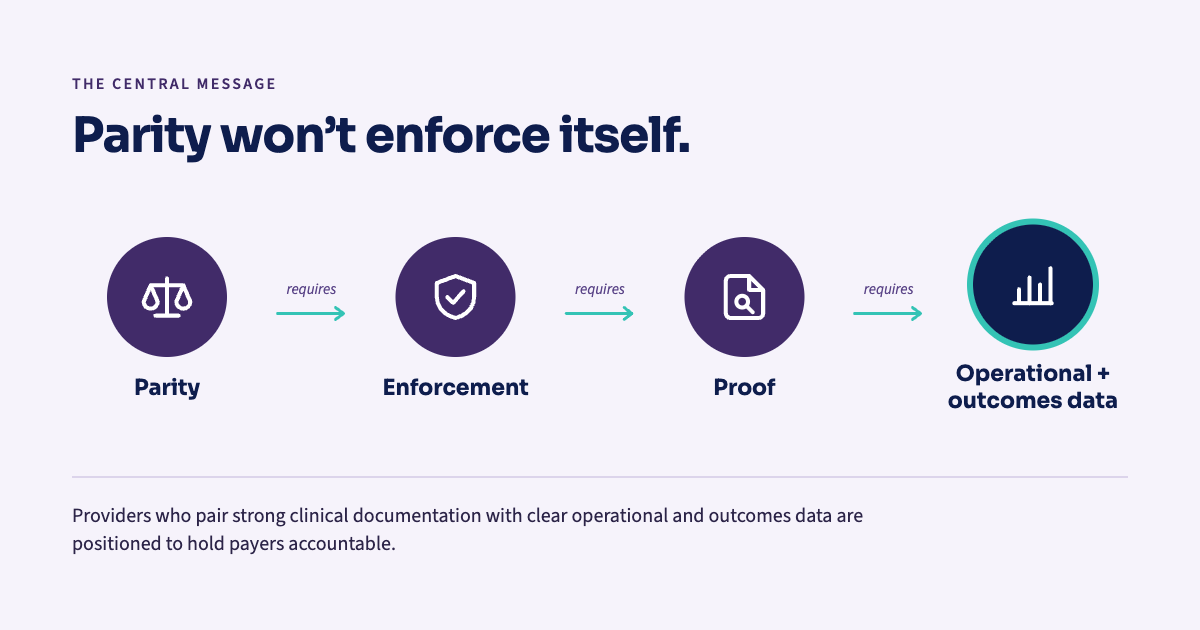
The central message was clear: parity requires enforcement, enforcement requires proof, and proof requires operational and outcomes data.
What Payers Want to See
Recaping BHOC27 Panel
Payer perspectives were refreshingly practical. Rather than complex or one-off assessments, payers favored simple, repeated quality-of-life measurements, captured consistently throughout treatment and continued through post-discharge follow-up. The value is in the pattern over time, not a single snapshot.
Building the Operational Case
As a provider, it’s vital to have documentation discipline that turns good care into defensible care:
Documenting treatment using ASAM criteria
Linking individual progress notes back to the treatment plan
Updating treatment plans as patients progress
Completing thorough discharge summaries
Panelists also recommended a focused set of measures for providers to track: payer-specific denial and authorization trends, regular documentation audits, and consistent use of two or three outcome measures. The emphasis was on doing a few things well, every time, rather than measuring everything.
Outcomes That Speak Payers’ Language
The conversation highlighted an example of longitudinal outcomes reporting that showed lower downstream utilization among patients who received behavioral health treatment.
That kind of evidence reframes behavioral health care as an investment rather than a cost and gives providers real leverage in parity conversations.
Q4 Payer Updates
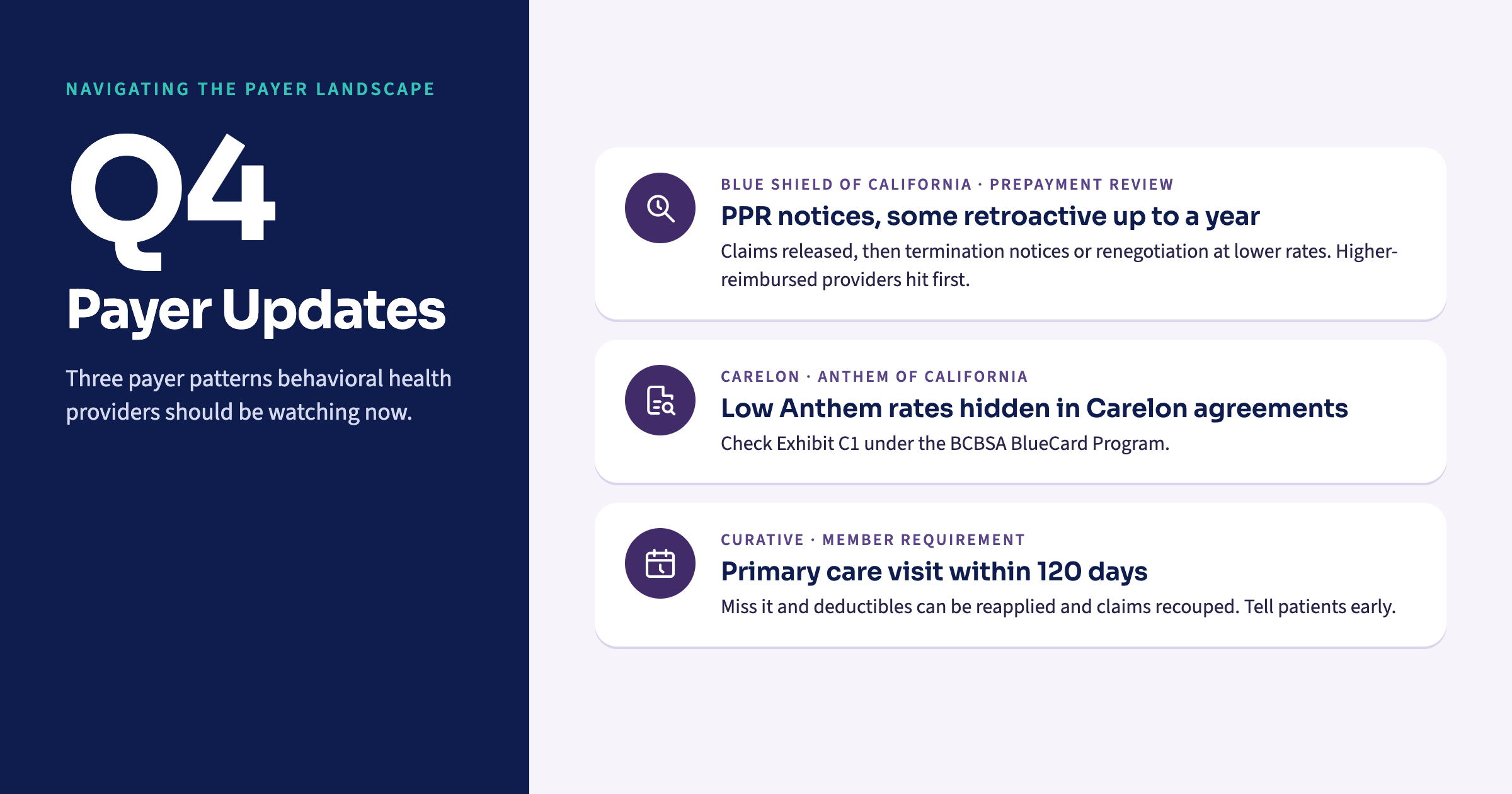
Blue Shield of California prepayment review. Some facilities have been placed into prepayment review (PPR), sometimes applied retroactively for up to a year. The pattern has included claims eventually being released, followed by contract termination notices and, occasionally, an opportunity to renegotiate at lower rates. Higher-reimbursed providers appear to receive PPR notices first, though providers paid average rates are also affected. The payer’s stated rationale involves fraudulently obtained California policies.
Low Anthem rates hidden in Carelon agreements. California providers should review their Carelon agreements carefully. Low Anthem of California rates may be buried in Exhibit C1 under the Blue Cross Blue Shield Association BlueCard Program.
Curative’s 120-day primary care requirement. Curative contracts require members to visit a primary care provider within their first 120 days of coverage. If they don’t, the deductible and out-of-pocket costs can be reapplied, and claims can be recouped. Providers should make sure patients understand this requirement early.
The Takeaway
Parity won’t enforce itself. Providers who pair strong clinical documentation with clear operational and outcomes data are the ones positioned to hold payers accountable and protect patient access to care.
At Hansei, that’s what we do every day: help behavioral health providers turn parity’s promise into paid claims. We hope you will join us on our next ROC to continue the discussion!